green robots
Voices from ChernobylGreen robots is the name given to the soldiers who worked on the roof of the ruined reactor, where high radiation repeatedly disabled remote-controlled machines. The phrase captures a bitter reversal: the machines built to do hazardous work could not be trusted, so young men in green uniforms became the most reliable instruments of cleanup. Their labor, performed at extraordinary speed and under inadequate protection, made the expression a record of human sacrifice as much as a description of their appearance.
Origin and meaning
The name arose because the soldiers’ uniforms were green and the radio-controlled machines often failed to obey commands—or did the opposite of what they were meant to do. Their electronics were disrupted by the intense radiation. Against that backdrop, calling the soldiers green robots is both practical and unsettling: the men succeeded where the machines failed, but the label also makes human beings sound like equipment deployed into a lethal environment.
The expression belongs to a wider account of the cleanup in which technical measurement and human judgment struggled against contamination that could not be seen. On a first trip into the Zone, a scientist measured forest radiation at five or six times the level on roads or fields; high doses were present more broadly, including in food and breast milk. In this landscape, the failure of machines was not an abstract engineering problem. It left people to undertake work that the machines could not safely or reliably perform.
Work on the reactor roof
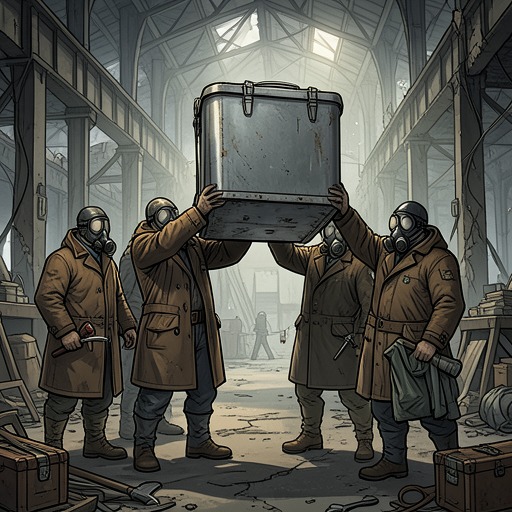
Three thousand six hundred soldiers worked on the roof of the ruined reactor. Their task was to gather fuel and graphite, along with pieces of concrete and metal, and throw the debris from the roof. A wheelbarrow took about twenty to thirty seconds to fill; the men then had roughly another thirty seconds to tip it. The special wheelbarrows weighed forty kilos even before they were loaded.
The work was organized in brief daily turns: a soldier might spend only a minute and a half or two minutes on the roof before being sent away. A lead vest and mask offered an appearance of protection, but the radiation came from below, where the vest did not shield them; their boots were ordinary, cheap imitation leather. Afterward, workers received a certificate and an award of one hundred rubles, then disappeared to distant parts of the country. The speed of the task and the short shifts did not make the danger remote; they show how narrowly the men’s exposure was managed while the contaminated debris was removed by hand.
The human cost behind the label
The soldiers slept on the ground in tents. At first, they spread straw on the ground, not knowing that it came from stacks near the reactor. The detail collapses the distinction between the dangerous worksite and the place meant to offer rest: contamination followed them into the material under their bodies.
The same account places the roof crews within a larger mobilization. Two hundred and ten military units were sent to deal with the consequences of the catastrophe, amounting to about 340,000 military personnel. The roof workers were a particular group within that vast deployment, described as young men who were dying years later. The label green robots can sound almost impersonal, yet the account insists on their age, their exposure, and the lives that continued after the brief, measured minutes on the roof.
Sacrifice and the limits of machinery
The expression also resonates with a separate emergency beneath the reactor. With water under the reactor threatening to combine with uranium and graphite into a critical mass, volunteers were sought to open a safety-valve bolt. The feared explosion was estimated at three to five megatons, with the potential to render not only Kyiv and Minsk but a large part of Europe uninhabitable. The men who volunteered repeatedly dived to open the bolt; the unit received 7,000 rubles, while promised cars and apartments were forgotten. The account presents the dives as acts undertaken not for material reward but as sacrifice.
That episode is distinct from the roof cleanup, but it sharpens the force of the expression: when technology and safeguards failed, the response depended on people accepting physical danger. The account calls the soldiers a sacrifice and remembers that the most reliable robots were human beings. Their green uniforms supplied the name; their labor, exposure, and disappearance from view give it its lasting meaning.